
I thought it could be fun to mix up our discussions on heavier and headier topics by breaking them up every now and then with a book review. Especially books that fit within the niche of this blog and pertain to theology, scripture, church life and Christian practice. I mean… this is called The SouthTown Pastor after all! And, although I am a major science fiction/fantasy/western/mystery fan, I think it might be much more helpful to any readers of this blog to help point them not only to heavy topics that warrant discussion in our present age, but also point them to good books that are worth their time.
With that said, I personally believe that this first book is well worth your time and it also helps to explain a little about the church that I am about to join as a co-elder and pastor. Not that it mentions my new church by name, but the practices contained within this book have been part of the ebb and flow of my new church for well over 20 years. As a Southern Baptist church, we’ve basically been making use of these ancient practices before they were cool in the Baptist world.
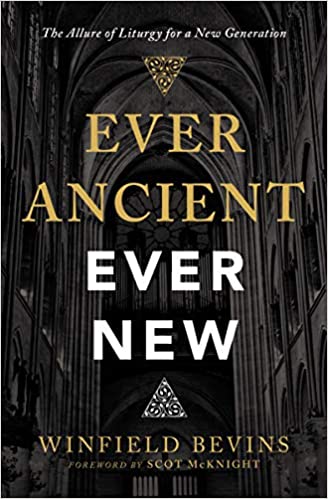
Let me say one final word before I dig into this book for you – I have (unsuccessfully) attempted to maintain blogs and book blogs in the past. In those attempts, I have tried to come up with some fun way in which to rate the books that I review to help make it a little more fun and a little more applicable to the theme of the blog itself. For the sake of keeping things as straightforward as possible, I think I’ll just stick with rating books the good, old fashioned way – with stars. I make use of Goodreads and have for quite some time, and stars seem to just make sense. Now that we’ve gotten that all squared away, let’s dig in to Ever Ancient, Ever New.
Review
The title “Ever Ancient, Ever New” comes from a quote from Confessions by St. Augustine of Hippo (354-430 AD) where he says, referring to the Lord: “Late have I loved you, O Beauty ever ancient, ever new, late have I loved You!“
As the back of the book notes: “For many years, articles, surveys, and news reports have lamented the steady flow of young people leaving the church in North America. Yet, while some are leaving, others are choosing to remain within the fold of Christianity and explore other expressions of their evangelical faith. They are rediscovering the beauty of a faith that is ever ancient yet ever new.
Ever Ancient, Ever New illuminates the growth of this diverse movement and explores the allure of a liturgy infused with historic Christian practices and rooted in creedal theology, introducing us to several churches and communities that foster this ‘convergence’ of old and new.”
There might be a lot of new words in that book description for some readers. Words such as “liturgy” and “creedal” have a tendency to legitimately frighten many in the evangelical world in the US, especially in the Southern region of the US. Trust me on this, I pastor in the Southern US and I was raised in the Southern US. I’m from what some affectionally call the “buckle of the Bible Belt.” Which has both its pros and its cons – but I digress.
For those who these words unsettle, as well as for those who are curious about the “decline” of the church in the US, this book is quite helpful. There is serious truth that many young families are abandoning the “faith” of their parents. There are many reasons to this, some of which I have become very convinced of through simple observation as a pastor, but what Bevins attempts to tackle in this book is the yearning of many for something more grounded and something more “real.”
Those of us who were raised in the evangelical church of the 80’s, 90’s, and 00’s, can attest to the fact that the evangelical church of our rearing was concerned mostly with the growth of numbers and less with a concern towards longevity and spiritual growth. At least, that’s how it was in my experience. Mega-churches abound in many places, all of which shuttle families into their little niches that sounds more like the Scarecrow’s account of being torn apart by the Wicked Witch’s flying monkeys than growth and discipleship in Christ. Dad goes over here, mom goes over there, children go their own way… and they’re all lucky if they worship together. The division of people, families, and couples into their various “life stages” ignores the benefit of Titus 2 ministry. But again, I digress.
In Ever Ancient, Ever New, Bevins draws upon the rich well of the historical church, its liturgy, and its practice. He divides the book into three sections that helps to aid the reader in their discovery of this “ancient path” of the faith. In 10 short chapters, Bevins is able to capture the spirit of what folks like myself discovered the first time we attended a liturgical service. I’ll handle the use of liturgy and tradition for Protestants in a later post – but Bevins skillfully explains why younger people are moving away from the mega-church and contemporary concert driven worship services for expressions of the faith that is being held up by 2000 years of history. As he notes, the liturgy roots us in the faith and with the faith of the whole church from all ages and from around the world.
Here’s why I’m recommending this book – if you’re unfamiliar or concerned about this trend in movement by young adults towards liturgical expressions of the faith, this book is only the tip of the iceberg in helping to explain why this trend is occurring. For those who are unfamiliar with the liturgical worship, this book helps to give you a good primer into what it is – and more eloquently than I can in a simple blog post. For those who are exhausted with trying to “make it” in the tradition of their parents and are considering giving up – this book helps to point you towards a very biblical and yet different way in which to experience your faith in Christ.
Yes, many are making the trek to Rome or to Canterbury – but not all. Here is where my church comes in. There are many Protestant Evangelical expressions of the faith that are discovering the beauty of liturgy and the historical church. If you are Baptist, as we are, then a helpful resource to discovering a Baptist church near you that embraces liturgy is the Center for Baptist Renewal. To put it bluntly – there’s no reason to abandon your Baptist (or Protestant) heritage if you don’t feel the Spirit leading you in that direction.
The liturgy is not for everyone, but neither is the status quo of the modern evangelical church. In our age of “post truth” or “make your own truth,” being part of a faith and religion that says that we have the corner on truth can be confusing and frustrating. Not only in reminding yourself why you believe it, but also in helping to explain to others why you believe it and why they should to. Yes, we believe that Christ is the Truth and the only truth (John 14:6), but in our post-modern world truth is constantly attacked for not being “my truth.” The beauty of the liturgy and the ancient church remind us that truth, real truth, has longevity. For folks like me, liturgy and other ancient and biblical practices of Christianity revived and renewed my heart in Christ. In Ever Ancient, Ever New any reader can get a quick primer as to why so many are finding renewal in the liturgy.
Get your copy here.
Rating:
Recommended Reading:
- Ancient-Future Faith, Robert Webber
- Ancient-Future Time, Robert Webber
- Evangelicals on the Canterbury Trail, Robert Webber
- Rome Sweet Rome, Scott Hahn
- The Accidental Anglican, Bishop Todd Hunter
- Resources on Baptist catholicity – Center for Baptist Renewal Bibliography

 The SouthTown Pastor