

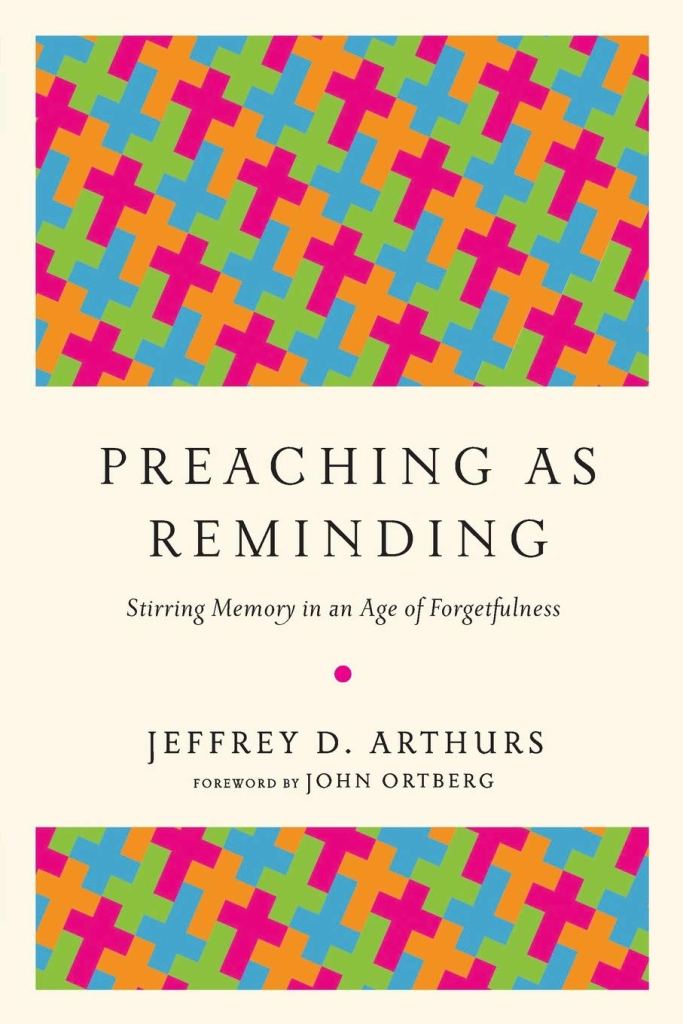
This month, I want us to look at a book that I read recently for a preaching class that I just completed for seminary. In class, we were split into two groups to give a presentation on a book, and this one was the book that I was assigned. Ironically, this book in many ways, speaks to much of my own convictions in ministry, especially the final chapter regarding the use of biblical ritual, ceremony, and symbol for the purpose of stirring memory within the church, so I was glad that I was put into this group.
Let’s dig in!
From the back of the book: We know of the preacher’s role as both teacher and proclaimer, but Jeffrey Arthurs adds another assignment: the Lord’s remembrancer. The remembrancer stirs the memory of Christ-followers, reminding them of the truths they once heard and fanning the flames of faith.
Preaching as Reminding describes the dynamic role of the remembrancer who prompts thankfulness and repentance, raises hope, fosters humility and wisdom, exhorts obedience, and encourages community.
With decades of preaching experiences, Arthurs explains how to stir memory through vivid language, story, delivery, and ceremony. He urges preachers to take up this task with buoyancy and hope because the Lord God has commissioned and equipped them to serve as the Lord’s remembrancers.
Review
Let me begin by saying that I thoroughly enjoyed this work! Now, with that said, let me also make a note that I do not plan on only reviewing books that I like. In fact, I have one that I’m thinking of reviewing for next month that I simply found “meh.” It was interesting and had some good things to take from it, but I have my issues. However, that can wait until next month. Let’s look at this one first.
As I mentioned above, there was much in this book that spoke to my own personal ministry convictions. From the start, Arthurs hits you full in the face with the problem of lack of memory as he opens his introduction: “If we have no memory we are adrift, because memory is the mooring to which we are tied. Memory of the past interprets the present and charts a course for the future.” Based upon our previous discussion regarding the Christian and Digital Distraction, this opening statement should grab and hold our attention. I believe we all can attest to the issue of the lack of memory, or even the lack of ability to retain information.
Throughout the work, Arthurs draws upon the work of Dr. Oliver Sacks, a neurologist, who worked with a man who suffered from Korsakoff’s Syndrome, a chronic memory disorder. By 1975, the patient (Jimmy), still believed he was a 19 year old sailor in WWII. Every morning, Dr. Sacks would have to reintroduce himself to Jimmy before beginning his previous day’s work on helping with Jimmy’s memory. While Jimmy was a real man, he serves as an example of all of us, especially Christians in the West, when it comes to the lack of memory in who we are. Arthurs notes that: “without memory, we are lost souls.” He absolutely right! In the age of intention distraction and scrolling, we have “no need” for memory… because search engines and smart devices will remember for us. In this church, the lack of memory is a by product of the cancer of distraction.
As he takes his reader through the book, Arthurs constantly reminds us that in Scripture, memory, symbols, sacraments, ceremonies, etc… serve as our reminders of God’s faithfulness. Without rewriting the book for you here, we can see where this argument is going. Yes, most Christians know the story of Noah & the Flood from Genesis 6-9 and the sign of the rainbow that God gave as a reminder of his promise to never again flood the whole earth. But, there are many more reminders throughout Scripture, not least of which is the Eucharist itself. However, at the same time, most folks sitting around us in the pew either don’t know of these reminders or why they are important for our faith in the Most High God. And that’s the purpose for which Arthur’s wrote this book.
He tells us in the first two chapters that God remembers, but God also intentionally forgets. He tells us that we forget, and we have to do the hard work of remembering. Which is where the elder/pastor/minister comes in. Starting in chapter 3, Arthurs begins the practical application of his work by reminding elders, et al that we are the Lord’s remembrancers, describing for us the very important work that ministers have in the lives of their parishioners. “Stirred by a preacher,” Arthurs states, “the listeners’ memory becomes participation.” And that’s the key, friends… by remembering what our God has done for us, through both covenants, we are brought into the participation of the entire community of believers past, present, and future (*ahem* one Holy, Catholic, and Apostolic?).
Throughout the rest of the book, Arthurs spends chapters 4-7 discussing different methods for ministers to make use of for the purpose of stirring memory (Style, Story, Delivery, and Ceremony/Symbol). In all of these, the covenant community of the church (whether local or universal) is brought into the participation of the faith in a way that we do not find while shopping at our local bookstore.
Response
Let me briefly note why I think this work is important for the church today, especially for those who covenant with a more “traditional” Baptist church (which is where the majority of my experience lies). I think this work is important because we Baptists have forgotten the importance of memory. I think this work is important because we have become too uncomfortable with the experience of Christ. This doesn’t have to mean in a charismatic sense (though it doesn’t have to exclude either, as long as it’s biblical). But, just as many Baptists (and I’m sure other Protestants) tend to reject anything related to liturgy, the Calendar, weekly Eucharist, etc… I think we have thrown the baby out with the bath water. We’ve reduced God’s symbols to something less than symbol to the point that the symbol is no longer important or meaningful. This leaves our churches full of people that trim down their “faith” and their participation in the Body of Christ to something that only meets their felt needs in the moment… or to something that they can put into a box. This is not what Christianity or the Church was ever meant to be!
Of course, not all churches are this way, even in the Baptist (or other Protestant) world. Some are coming to see the beauty of the liturgy or the beauty of regular partaking of the Lord’s Supper. Some are coming to see the beauty of the Christian year, even in private observance, if not in corporate observance.
Now, this doesn’t mean that a church must adopt ancient liturgy or the Christian year in order to stir memory among their parishioners. There are definitely other practices, and that’s where I think this work is very beneficial. It helps to at least start the conversation on how to draw our people more into remembrance of and participation in Christ and his Body.
And that’s why I wanted to review it, not only because I read it, but because I want to start this conversation. Why is memory so important if we can just search for the answers on our devices? Why is participation so important in an age of isolation (especially during the COVID19 era)? Can’t we get the same “experience” at home that we can get in the gathered worship? This book doesn’t pretend to answer all of these questions, but it does force us to ask them. I loved this book, and I recommend it to all pastors, regardless of your denominational background.
Get your copy here.
Rating

 The SouthTown Pastor