
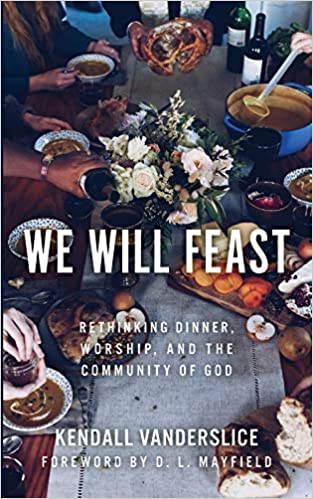
Here we are again at the end of yet another month, which means it’s time to look at yet another book about Christian life and practice. This month, I want us to take a look at this quick read by Kendall Vanderslice called “We Will Feast: Rethinking Dinner, Worship, and the Community of God.” As I promised in our last book review, my goal is not to always review books that I like, but books that cause us to think (or even rethink) some of our practices. We Will Feast meets that criteria.
Let me preface this review with a clarifying statement: I think that Vanderslice brings up some valid and challenging critiques of how church is “done” today. Specifically speaking on how church is done at, sometimes, the exclusion of the “least of these” (Matt 25:40) or even those who have (sadly) been hurt by a church in the past. However, and I’ll dig more into this as we walk through this review, I do think that Vanderslice falsely sacrifices orthodoxy for orthopraxy. I’ll define these terms below, but first, let’s look at the premise of the book.
From Goodreads: The gospel story is filled with meals. It opens in a garden and ends in a feast. Records of the early church suggest that believers met for worship primarily through eating meals. Over time, though, churches have lost focus on the centrality of food— and with it a powerful tool for unifying Christ’s diverse body.
But today a new movement is under way, bringing Christians of every denomination, age, race, and sexual orientation together around dinner tables. Men and women nervous about stepping through church doors are finding God in new ways as they eat together. Kendall Vanderslice shares stories of churches worshiping around the table, introducing readers to the rising contemporary dinner-church movement. We Will Feast provides vision and inspiration to readers longing to experience community in a real, physical way.
Review
Let me begin this review by giving you a definition of the terms orthodoxy & orthopraxy. I know I usually do this under a separate subheading, but these terms are easy to quickly define. Orthodoxy simply means “right belief” whereas Orthopraxy means “right practice.” For the sake of our non-Christian audience, let’s assume that the word “right” in these definitions means “proper.”
As I noted above, I do believe that Vanderslice brings up a great many valid points throughout her work regarding how church can be “done” in order to reach people who have either been hurt by the church in the past (which is a sad reality) or who would never consider going into a “traditional” church building. To sum up, her premise and her thesis is the proposal of what is called “dinner churches” or churches who hold services around the dinner table.
Your first thought might be the same as mine: “That sounds like a great idea! It tears down the barriers that keep so many from attending church that feels stuck in tradition and rote routine.” These are valid points, however let’s keep our definitions of orthodoxy & orthopraxy in mind. In our current, post-modern, cultural context we cannot divorce proper belief from proper practice. While I love the idea of gathering around the dinner table (and I completely agree that this is something that has been shamefully neglected, especially in evangelicalism over the decades) I personally have an issue with regularly “doing church” around the dinner table.
Here’s why (and it’s not because I’m a pastor/preacher): regularly doing church around the dinner table places more emphasis on orthopraxy than it does on orthodoxy. But, it does so at the expense of orthodoxy. The sentiment of wanting to be approachable and a place of comfort for those who have been hurt by the church or would never enter a church is a good and right sentiment. However, if we are “winning” people to a style of church or a particular practice of church, are we really “winning” them to Jesus or are we just “winning” them to the dinner table? Ultimately, my issue with Vanderslice’s premise is this: When we divorce orthodoxy from orthopraxy, orthopraxy becomes about felt needs and not about biblical orthopraxy, right and proper biblical practice of the faith.
I do believe that Vanderslice is attempting to recapture a biblical picture of orthopraxy in this dinner church idea. But, as you make your way through the book, it quickly becomes evident that orthodoxy (right/proper belief) is shed for the sake of practice. Essentially worship and evangelism are blended – but these tasks are not the same. Worship is for the redeemed, for those who have placed their faith and belief in Christ Jesus crucified and resurrected. Evangelism is for the lost, for those who have not placed their faith and belief in Christ Jesus crucified and resurrected.
Allow me to give you an example, in Vanderslice’s own words, to help make my point.
She (rightly) notes on pg. 35, “Community is not just a nice addition to the life of faith; community is central to the very foundation of the faith.” I would wholeheartedly agree with this statement! If you know me, you will quickly gather that Christian Community is a key factor of Christian life that I personally focus in on like a hawk. Christian Community is one of the main reasons I became a pastor (other than the obvious call of God on my life). But, let’s note a that she uses the word “faith” twice in that quote. This faith is the “faith once for all delivered to the saints” (Jude 3), this is faith that, by the grace of God we have been saved, in Christ (Eph. 2:8-9), this is the faith by which we have “assurance of things hoped for” and “conviction of things not seen” (Heb. 11:1). Finally, this is the faith through Christ Jesus that we have obtained access to God and “we hope in the glory of God” (Rom. 5:2). To put it bluntly – the community of faith is only made up of those who have placed their faith in Christ Jesus.
Yes, let’s invite in the atheist, the Muslim, the Buddhist, the homeless and the prostitutes. Let’s invite them in for a meal. Let’s talk with them about Jesus. Let’s be like Jesus and associate with those that the typical “religious” crowd ignores. But… let’s not just associate with them, let’s invite them to place their faith and belief in Jesus, which brings them into the “community of faith.”
Throughout her work, Vanderslice chronicles her visits (pre-Covid19) to multiple dinner churches throughout the US and how they have seen growth and healing for many who have been hurt by the church in the past. This is a wonderful thing. But, to call oneself a church belonging to Jesus Christ, one must take his word (the Bible) seriously. This is the major faulting of the model of the dinner churches that Vanderslice visits.
That said, however, I do believe that this model of dinner church is one that can be embraced and should be embraced by churches seeking to reach those who have fallen away from the church or have been hurt by the church (or even as an evangelistic tool). But, we shouldn’t confuse this with true worship. Can we worship in these settings? Yes! But, worship is for the redeemed, not the lost. When we invite those who do not know Jesus to share the table with us, our goal is to lead them to Jesus and to give them Jesus… not confirm them in their sin and give them a false assurance of salvation.
So, what’s my suggestion on this book? Read it! I think she makes some valid points. However, read it with an eye toward Scripture (as we should all things) and “test the spirits” (1 Jn. 4:1). I think Vanderslice gives us a lot to think about. I love her “theology of food” and she has given me plenty of other sources and works to read, all of which I will plan to review here. But, just to tie this whole thing together like a good rug, we need to keep orthodoxy and orthopraxy hand in hand. When we divorce the two, we’re setting ourselves up for failure. Maybe not before the world, but definitely before the God that we claim to believe in and worship.
Have you read this work? What are your thoughts? What are your thoughts about the issues proposed here? Let’s discuss!
Rating

 The SouthTown Pastor