
The Lord is here! His Spirit is with us!
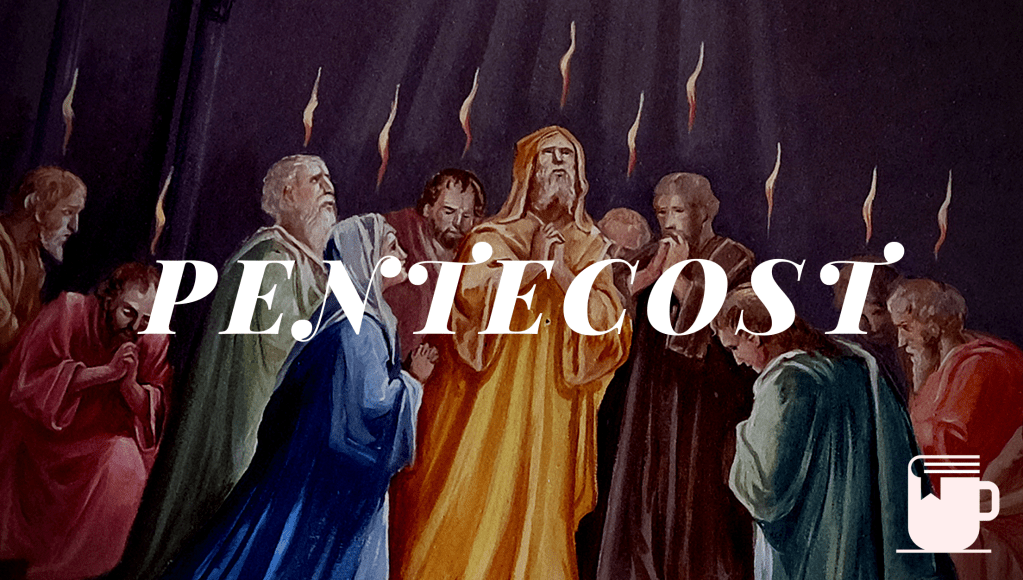
Welcome to Pentecost friends! We have come to the end of Eastertide, Christ has Ascended, and His Spirit has been poured out on all flesh (see Joel 2:28-29 & Acts 2)! Today (well, technically yesterday) begins the season known as Ordinal Time or Ordinary Time. I’ll elaborate more or the season of Ordinary Time in a few weeks in a seperate post, but for today, let’s take a look at the Day of Pentecost and why it is celebrated in the Christian Year.
As we have done in the other two posts on in this “Christian Year” series, let’s begin by helping those readers who are unfamiliar with the Church Calendar understand what this word is and where this celebration comes from.
What is Pentecost?
First, let’s consider the word itself. What does it mean? Pente sounds a little familar to our ears, especially in the US where we have the Pentegon, that 5-sided building that houses the Department of Defense of the United States government.
That prefix “pente” is key here. In Greek, Pente means “5” – hence where we get the word Pentegon. We also use this word in referring to the 5 books of Moses as the Pentateuch.
So… what about Pentecost? Pentecost also comes from the Greek, but instead of meaning 5, it actually means 50th.
Now that we have an understanding of the word itself, how does it relate to the Christian Year/Church Calendar? Because calendars are made up of days, Pentecost refers to the 50th Day! 50th Day from what? (Here’s your Christian Year connection)… from Easter! So, Pentecost is literally the 50th Day after Easter Sunday.
Big whoop, right? Why celebrate this regularly in the church? If you’re like me and were raised in what is known as a “typical” SBC church in the rural south, words like Pentecost, Lent, and even Eastertide just sound too Roman and too unbiblical. If you didn’t grow up in this kind of tradition, let me note a quick disclaimer: it is not uncommon at all to hear from the pulpit that these words are unbiblical. Hopefully, by now any regular reader of this blog will know that I’m going to ground this whole celebration in Scripture, so let’s begin there as we seek to better understand Pentecost.
Biblical Support
Does Pentecost have biblical support? Yes! If you are even remotely biblically literate, or have attended church that has a high view of Scripture, then your mind probably goes directly to the book of Acts. I won’t quote the whole chapter here for sake of space, but I will link it here for you to read and then jump back over here to finish this post.
Now that you’re back, let’s make a few notes about this text. What we see here in Acts 2 is the pouring out of the Spirit of the Lord on all flesh. As Peter notes in his sermon, this is a fulfillment of God’s promise in Joel 2:28-29. This is also a fulfillment of the “promise of the Father” that Jesus notes in John 15:26-16:15, Acts 1:4-8, as well as other places throughout the Gospels. Because this promise is now fulfilled on Pentecost (and then subsequently in other key texts in the book of Acts), what we have at Pentecost is nothing less than the birth of the Church.
A valid question to ask here is, “why 50 days after Easter?” I could respond in a similar way to Jesus at the beginning of Acts and state that “it is not for you to know the times or seasons that the Father has fixed by his own authority,” but if we’re being honest, this would come across a little snotty because I’m not Jesus. This response also wouldn’t be beneficial because, in the revelation of Scripture itself, God doesn’t leave us blind to how he has worked out his timing and the seasons that he would have us celebrate.
Something for anyone unfamiliar with Christianity needs to grasp to better understand the Christian faith is that Christianity is very Jewish. I don’t mean it in the sense that Jews and Christians are the same (we’re not, particularly because of the embracing of Jesus as the Christ), but Christianity is very Jewish because Christianity was birthed out of Judaism. Therefore, many of the Jewish seasons, liturgy, and practices were carried over and those that found fulfillment in Jesus as the Christ (such as the sacrifices) were dropped.
So, for example, did you know that Pentecost was actually a Jewish feast before it became a Christian one? This explains why, as Acts 2:5 points out to us, “there were dwelling in Jerusalem Jews, devout men of every nation under heaven.” This doesn’t mean that a whole bunch of Jews from all over the known world decided to up a move to Jerusalem at once. Rather, they were already in Jerusalem for the feasts beginning first with the Feast of Unleavened Bread (Passover) and culminating 50 days later for the “Festival of Weeks” (also known as the Feast of Harvest and Day of First Fruits). We can find references to these feasts littered in the Pentateuch, specifically in Exodus 23:16, Leviticus 23:16, and Numbers 28:26.
What’s my point? My point is that Pentecost is a biblical celebration, not only because we have evidence for it in the New Testament, but because God had ordained this season in the Old Testament. It was no coincidence that Jews from all over the known world were living in Jerusalem when the Spirit was poured out! God does nothing by accident.
Continued Celebration
Let me begin this section by asking a few valid questions that may come up at this point:
Just because we have biblical support for Pentecost, does this mean that the church should continue celebrating it? Scripture is closed. God has revealed himself through his work and word and we have what we need to obtain salvation in Jesus (see John 20:30-31), so why would we continue to celebrate this season?
Again, these are valid questions. We won’t get off into the debate over Normative Principle vs. Regulative Principle in this post, nor will we debate the continuation of signs that our Pentecostal and Charismatic friends would likely point to here. Instead, for this first post on Pentecost, I want to address a very pratical reason to celebrate Pentecost year after year and it’s this: Celebrating Pentecost renews our realization of what the Gospel is by vividly reminding us that the Gospel of Jesus Christ is for “every tribe and tongue and people and nation.”
So, as a “typical” SBC church in a rural area that has no desire to become litugical (which is okay!), why would a pastor of that church want to regularly celebrate Pentecost? Because is proclaims the Gospel! It proclaims the Gospel because the Church is born! Pentecost proclaims the Gospel because it reminds us of our Great Commission given by Christ himself to “make disciples of all nations.“
There is so much good theology that we could bring up and debate on the greatness of Pentecost but consider this and then we’ll be done for this week – Pentecost reverses the curse of Babel from Genesis 11:1-9. While we may have every language under the earth and while there may not be a person in your 35 person church off a backroad in rural Mississippi that can speak anything other than “good ole boy” English, Pentecost gives us a language with which to speak to all mankind… and it’s the Gospel of Jesus Christ.
Are you biblically required to celebrate Pentecost? Of course not. Should you? Absolutely! If the point of a Christian Church is to faithfully live out the Great Commandment and the Great Commission, then Pentecost helps us to do both in very beautiful ways. And because humanity is a fickle creature who is prone to forget, we need this annual reminder as much as we need air in our lungs and food in our stomachs.
Final Thoughts
Okay, I lied. I’m not finished yet. I want to note one other important aspect to Pentecost before finishing up this post, and it brings us full circle to how we began this post – The Lord is here! His Spirit is with us!
Pentecost reminds us not only are we to live out the Great Commandment and Great Commission, but it also reminds us that we are not abandoned by Jesus. I think for the Christian, this is a great hope to be reminded of on an annual basis. For the non-Christian, this hopefully gives you a deeper understanding of why true Christians are so committed to what we believe. The one who has called upon Christ has received the Spirit. This Spirit not only convicts us of sin, He also helps us grow closer to Christ as well as remind us that our God now dwells with us and in us (see Ezekiel 36:26-27). This is a wonderful promise. And while we don’t need a particular holiday marked on the calendar to force us to celebrate this truth, it is to our benefit to celebrate Pentecost for the purpose of being reminded of this truth.
Does your church celebrate Pentecost? How so? What is your normal habit?
What further questions do you have?

 The SouthTown Pastor
One thought on “The Christian Year: Pentecost”