
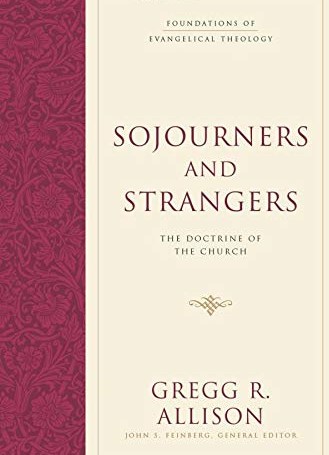
Greetings and Salutations readers! Welcome to the end of May and yet another book review. This month, I wanted to look at a book that I had to read for one of my seminary courses. While this might not be one that you would normally pick up for your summer beach vacation, I do think it’s one that we can discuss here for the sake of anyone who may be interested in the Doctrine of the Church.
Before I review this work, I do want to define a few terms for those who may be unfamiliar with the “Christianese” that is likely to be used on this blog. I also want to offer a disclaimer: This book was a bit tricky for me, which is why I want to give a review here. It was tricky because I’m very much interested in this topic, but I did not enjoy this book as much as I wanted to. So, this review is a bit of a mixed bag. But I digress, I’m getting ahead of myself. Let’s define a few terms and then quickly review this work.
Defining Terms
Doctrine – First, allow me to define the term doctrine again for those who have forgotten or if this happens to be the first post on my blog that you happen to read. Doctrine simply is a “Christianese” word for “teaching.” A formal definition of Doctrine is “a belief or set of beliefs held and taught by a Church, political party, or other group.” So, as we go through this and subsequent posts, just know that I will use the terms “doctrine” and “teaching” interchangeably.
Ecclesiology – Another term that I want to define is the word “ecclesiology.” For many, this word is completely foreign and they’ve probably never heard it before in their lives, even if they are “lifelong” Christians. Ecclesiology is just the fancy “Christianese” and theological term for “The Doctrine of the Church.”
I wanted to define these terms simply because I may use them frequently and I want all of you to be able to understand my lingo. Lingo can make or break a conversation, even if it’s a conversation that is carried on through the medium of a blog. So, it’s always helpful for us to be able to understand one another’s lingo and how we use terms. With that said, let’s take a closer look at Sojourners and Strangers by Gregg Allison.
Review
On the front end, let me note again that I had to read this work for a class on the Doctrine of the Church. That class was “taught” by Dr. Allison. Therefore, surprise surprise, he had us read his book on the subject. Honestly, this is not all that uncommon in higher education.
Anyway, I noted this above, but this book was a bit tricky for me. I love talking about the church, being in the church, and even just sitting in an empty church. I love to discuss ministry and theology and good books and church history and pastoral responsibilities with people. So, it’s safe to say that when I decided to take a class on the church, I was excited.
This book will, quite frankly, dull some of that excitement. It is a very thorough and very academic work. It is well researched and it is academically well written. But, at the same time, it is not written for a casual reader. With that said, however, if you are slightly interested in learning a little more about the doctrine of the church, this is a fine resource because it is a general overview resource. It does go into greater detail in certain areas of church life and practice, but you will not walk away from this book with a lack of information on who the church is and what her ministries should be.
Another point of note here is that this book is written primarily from a Baptist ecclesiology point of view. Even still, Dr. Allison does give appropriate time to other denominational viewpoints. What I do think that he does well is to explain how Scripture lays out a certain standard for the church and then moves to explain how it is typcially practiced in most denominational forms. Dr. Allison also does a good job of giving his own opinions on how the church should operate and how he understands the commands of Scripture (and why wouldn’t he? It is his book!).
What I did not like about this book was that, frankly, it’s too wordy. And this is a critique coming from someone who enjoys reading academic works. He’s very repetitive. While this is common for academic works, I believe that he unnecessarily gives a summary before and after every chapter, every section, and every subpoint. This book could have easily been 200 pages shorter than it is based solely upon his unnecessary summaries.
I really wanted to like this book (and this class) but if I’m being honest, I really didn’t. I didn’t enjoy the class for a myriad of reasons, but I didn’t enjoy the book due to the unnecessary lengthiness of the work. Even still, I would recommend this book for 2 reasons:
- For someone who wants a resource to learn more about the doctrine of the church. If you are wanting to have a better grasp on who the church is, what her ministry is, what her goals are, and why a biblical church does what it does, this work is a good one to check out.
- I would also recommend this work for pastors and lay leaders in the local church. This could easily be part of a pastoral or church library (which is exactly where mine is headed, so CCC readers feel free to grab my copy to read). This book would be a helpful resource if you are planning either a sermon series on the church or a small group/Sunday School class on the church. The bibliography is also extensive enough that one could easily find other resources to help in learning more about the Doctrine of the Church.
Have you read this book? What were your thoughts? Let’s discuss in the comments!
Grab your copy here.
Rating

 The SouthTown Pastor