

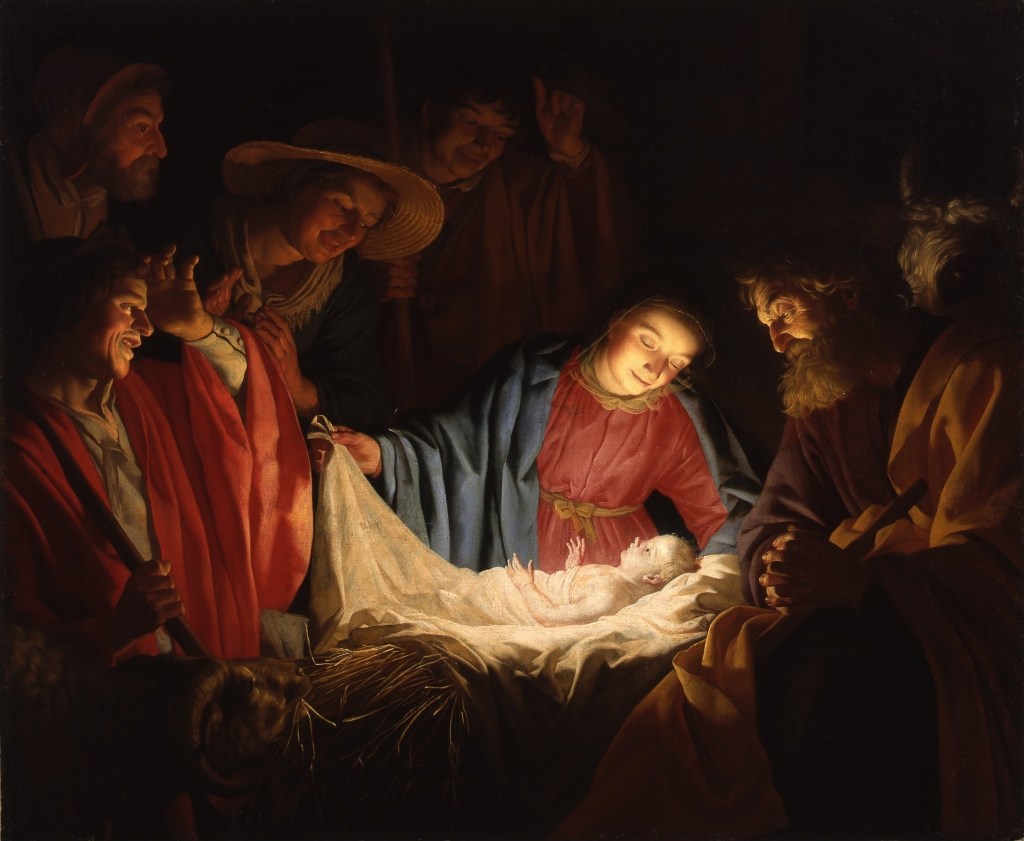
I have been meaning to write a few posts over the course of December, particularly about the Church season of Advent and Christmastide. And while this blog is and was intended to inform and discuss these topics with those that happened to read it, I decided against it. Partly because, as I have mentioned in my last few posts, I have been finding it hard and difficult to sit down and write. My brain just hasn’t seemed up to it. The other reason, and I wish this was the more prominent one, is that I simply wanted to experience these seasons with my church for the first time in over a decade.
I believe I have mentioned in this space before (and if not, then I know that I have mentioned it in personal conversations), but the church in which I am no fortunate to serve as an elder and the preaching minister has contributed to my life and spiritual well-being more than most of the folks there (and those who have left) could possibly ever know. I count myself lucky and in God’s grace in order to be back among them. So, it has been simply joyous to experience Advent with them again. It has been joyous to experience Christmastide with them for the first time (because, as a college student, I would head home to spend the holidays with my family, which was right and good).
Speaking of Christmastide, while this isn’t a post on the season, I should probably give those of you who are being thrown off by this term at least a little bit of an inkling of what I’m talking about before I mention the point of this post.
Christmastide is simply the season of Christmas. One of the many beautiful aspects of following the Liturgical Year is that it is not dependent upon the commercialized season of Christmas (enter Charlie Brownesque complaint here). Most of us are fully aware that certain retailers and craft stores begin putting out their Christmas (or “Holiday” to be more PC) decorations right after Labor Day if not before. Therefore, by the time Christmas Day finally arrives, everyone is ready to take down the tree, turn off the carols, and move on to Spring.
But… in the life of the church… we lead up to Christmas with the Season of Advent (a word which simply means “arrival” or “coming”). Advent is the church’s season of Waiting… we’re waiting to celebrate the first coming of the Lord Jesus as a babe in the manger. We’re waiting to celebrate the mystery that is the Incarnation of God in the Flesh. Just as importantly, we’re also reminded that we’re waiting on his second Advent, his second coming, his second arrival – not as a meek and mild baby in a feeding trough, but in power, glory, and authority.
Then… four weeks after Advent begins, we reach Christmas Eve. We read Scripture, sing carols, light candles, and celebrate that He was born so that “man no more may die.” And then… and here’s the beautiful part of not letting retailers and civic calendars direct our lives… then we have twelve wonderful days of Christmas (yes, the same as the song. And yes, each element in the song has Christian themes: Today is currently the fourth day of Christmas – the day of the “Four calling birds” – representative of the four Gospels).
So, as I sit here with my coffee on a wet and unseasonably warm December afternoon in Tennessee, I have been mulling over the message from this past Sunday that I delivered to my sweet congregation. If you go to the home page here on the blog, you’ll see an audio player that should have the sermon for your listening pleasure. But, this past Sunday’s text was from Luke 2:41-52 and centered on the boy Jesus in the Temple. One of the challenges that I have discovered over this past year of preaching through the Lectionary is that, sometimes, I have been tempted to try and let the season dictate the text, instead of letting the text guide the message. (Note: This is a regular challenge, I think, for most preachers since we all come to the Scriptures with our preconceived ideas of what we think it should say or what we want it to say to our churches in their particular season of life). But, the challenge in this text was simple: How does that scene in the life of Jesus relate to Christmas?
I won’t spoil the message for you, please go listen to it and then comment your thoughts below on this post – but I think I figured it out while still allowing the text to guide the direction of the message. At the same time, though … the more I reflect upon it, Luke’s Gospel becomes more and more fascinating each time I read it.
Luke was a Gentile, a physician, and a historian. Luke was a traveling companion of the Apostle Paul. And, as far as we can tell based upon Luke 1:1-4 and Acts 1:1 (and common practice of the time), Luke was writing to a Gentile benefactor named Theophilus. However, just because Luke was a Gentile, he was completely aware that his Gospel account would also be read by a Jewish audience. Which brings us back to the title of this post. While prepping for the sermon this past Sunday, simply due to delivery time and preparation time, I left out an interesting discovery that I made that might not come as news to some of you, but most definitely did to me: Luke uses the Old Testament requirement of “two witnesses” to help give his Gospel even more authority, particularly to his Jewish readers.
Now, I haven’t fully studied this, and it’s simply a thought just bouncing around in my brain that I’ll need to work through before bringing this into the proclamation of God’s word to God’s people – So, if you’re reading this and you’re part of my church community – don’t be surprised if we look at this together the next time we’re in this text!
For the sake of “proof,” allow me to point to a few examples and then I’ll publish this post for critique:
- First, let’s handle the “Two Witnesses” requirement. The command is found in Deuteronomy 19:15 which states: “A single witness shall not suffice against a person for any crime or for any wrong in connection with any offense that he has committed. Only on the evidence of two witnesses or of three witnesses shall a charge be established.” And while this is Old Testament, this same practice is used throughout the New Testament, particularly in Revelation, where the Lord uses two witnesses in order to lend authority to the prophecy being made. Luke would also record for us in Luke 10 that the Lord Jesus sent out the disciples “two-by-two.” The point here is this: Multiple witnesses lend authority. They lend the perspective of multiples to give a more accurate account of the events. This is why the Law required that at least two witnesses were needed in order to move forward with prosecuting a crime – the same pattern would be used to also lend authority to the preaching of the Gospel. One guy is a rogue. Two gets attention. Seventy-Two? People are going to pay attention. More than 500 (1 Corinthian 15:6) – now you have a movement!
- So, where does Luke use this pattern? Or, at least, where did I start seeing it? I mentioned this in the message from this past week, but Luke uses the technique of “bookending” in his Gospel. For example, he uses angels to herald both the birth and the Resurrection of Christ. Here’s where I did not take it in the sermon … that same technique also begins to establish the “two witnesses” pattern as well.
As I mentioned above, I’ll need to work this out and study it more, but in just the first two chapters alone, consider these examples:
- Gabriel’s two visits to both Zechariah (John the Baptist’s father) and Mary in order to announce miraculous pregnancies (Luke 1:4-38)
- Both Elizabeth and Mary’s exclamations regarding the blessedness of both Mary and the unborn Christ (Luke 1:39-45).
- Both Elizabeth and the unborn John the Baptist’s filling of the Holy Spirit pointing to the unborn Christ (Luke 1:39-45, also see Luke 1:15).
- The angels heralding Jesus’s birth and eventually his Resurrection (Luke 2:8-4, 24:4 – note here that there are two angels at the empty tomb. If you really want to have fun, note also that after the Lord Jesus ascends, two angels urge the Apostle’s to return to Jerusalem in Acts 1:10-11)
- Simeon and Anna at Jesus’s presentation in the Temple (Luke 2:22-38).
- I think I could even make this case from Luke 2:52 where Jesus grows in favor with God and with man. It might be a stretch of Origin like proportions, but I think it works.
Again, this requires some study, and it may not be a brand new thing for some of you, but having one of those lightbulb moments while studying Scripture is always a lot of fun. Thankfully, I have somewhere like this (and a regular podium in front of a wonderful group of God’s elect) in order to work out these ideas in a way that I pray edifies and uplifts the body of Christ.
Grace and Peace to you in Jesus at the end of 2021. I pray that you and your families have had a wonderful celebration of the birth of the Lord and that you have the happiest of New Years! May God bless us in 2022!
Peace of Christ!
The SouthTown Pastor

 The SouthTown Pastor