
Welcome to a new week, readers! As you can guess, this week we’re going to begin a discussion on the 5 Solas of the Protestant Reformation. Why? Because we are 5 months out from the 504th anniversary of the start of the Protestant Reformation (October 31, 1517) and this series of posts will take us right up to that celebration.
(As a side note, my church will most likely be celebrating with a “Reformation Day Feast” which will consist of tasty German foods. So, if you’re in the Jackson, TN area, come on out! The date in October is still TBD.)
While we are going to be discussing the first of the 5 Solas today, it is important to give a short history to help set the context. But first, what are the 5 Solas? They are:
- Sola Scriptura – Scripture Alone
- Sola Fide – Faith Alone
- Sola Gratia – Grace Alone
- Solus Christus – Christ Alone
- Soli Dei Gloria – to the Glory of God Alone
History
There’s a lot that goes into the history behind these Solas and the Protestant Reformation. In fact, there have been volumes of works written on each Sola, the history of the Protestant Reformation, the Reformers, theology, the Roman Catholic Church, and even on what led up to the Reformation. Because this is a blog, obviously I’m not going to be giving a comprehensive history, but just enough to “wet your wistle” and then I’ll give you some resources at the bottom of this post if you’d like to study further (which I would recommend to any Christian… these are good things to know, remember, and be able to discuss with other believers, regardless of which stream you swim in [Tiber, Rhine, and whichever river is associated with the Greek Orthodox Church]).
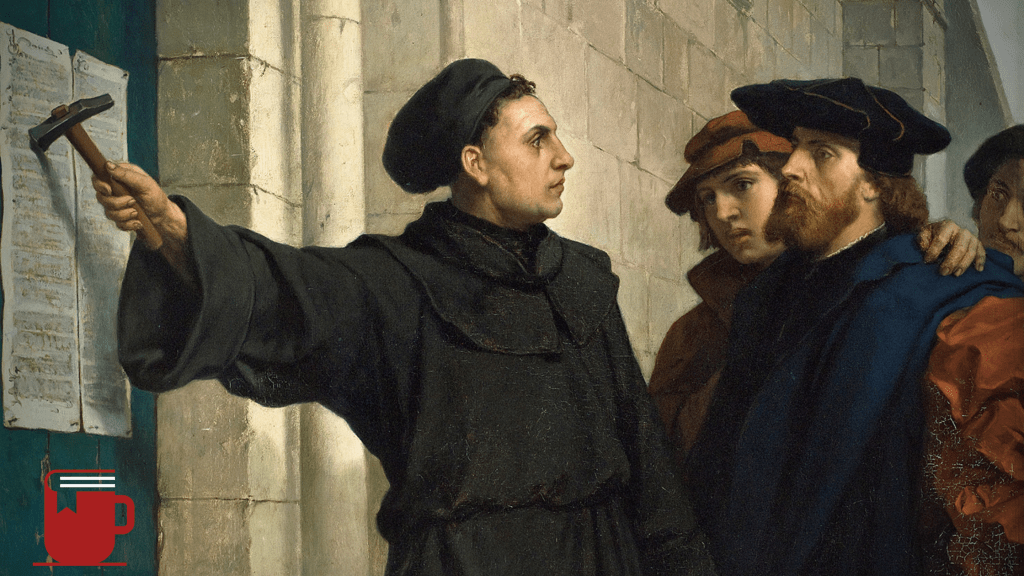
Quickly then, what is a short blog sized history of the Protestant Reformation? History understands that “the spark that changed the world” occurred on October 31, 1517 when German monk, theologican, priest, and teacher Martin Luther nailed 95 Theses to the church door in Wittenburg, Germany. Martin did this in response primarily to the selling of indulgences which promised the immediately release of a loved one from Purgatory. These indulgences were to help with the restoration of St. Peter’s in Rome, which had fallen into disrepair.
Martin’s “Theses” were intended to spark debate and discussion over the theology and purpose of these indulgences. In fact, Martin had no desire to break with the Roman Church until it became obvious that there was no way forward (well, that and the fact that Pope Leo X excommunicated him in 1521).
Out of the Reformation, and out of Martin’s own defense of his writings and arguments from the Diet of Worms (1521) we begin to see the formation of the 5 Solas. The main thing that a newbie to the history of the Protestant Reformation needs to grasp is this: the Reformation and these 5 Solas challenged the structure of the Roman Church, the authority of the Pope, and even the Magisterium of the Roman Church (specifically this first Sola).
Obviously there is quite a lot more that we can discuss (and we may as time goes on) but this is enough to get us started for the time being. Let’s press forward!
Sola Scriptura
Why is Scripture Alone the first of the 5 Solas? Honestly, I personally don’t think it matters, but there is value in starting here as a Protestant because biblical Protestants argue that all arguments regarding salvation, theology, and Christian life begin and end with Scripture. This does not mean that biblical Protestants are solo Scriptura (Scripture Only). Rather, we uphold the authority of Scripture, as the inspired word of God (2 Timothy 3:16, 2 Peter 1:20-21), as the final authority on all matters regarding salvation, theology, and Christian life. We see Scripture as inerrant (without error) and infallible (incapable of making mistakes or being wrong). This is how these 5 Solas challenged (and continues to do so) the authority structure of the Roman Church, which has final say over how Scripture should be interpreted and understood not how Scripture interprets itself. These are major differences that we can discuss in later posts, but for now, let’s continue with our discussion of Sola Scriptura.
Quite frankly, this doctrine (teaching) is what continues to be debated among Christian theologians and intellectuals (and even Christian laypersons) in much of the cultural debates that have taken place over the last 60 years. Because of our convictions on the final authority of Scripture, biblical Protestants take Scripture at its word on matters of marriage, sexuality, gender, race, and human authority. Futhermore, biblical Protestants take Scripture at its word when it speaks to such matters as church government and structure, the sacraments and their meaning/use, human dignity, the sancitity of life, and most importantly salvation (i.e. how one comes into a right relationship with a holy God). Understanding this particular sola, especially as it relates to what we now label as “conservative” Christians, can help one when they are wondering why a Christian approaches certain issues (such as marriage or abortion). It has nothing to do with trying to “impose” our worldview upon others as much as it has to do with our understanding of how God himself views his creation and how he has structured it to behave under his authority.
Sola vs. Solo
Sadly, this is not part of the “who shot first” debate against Han Solo. Rather, I wanted to briefly ellaborate on the Sola vs. Solo issue. Among evangelicals, there is a misunderstanding of Sola Scripture as meaning “No Creed but Christ” (which is, ironically, a creed itself). As I defined above, Sola Scripture does not mean Solo Scriptura. Scripture Alone is not Scripture Only.
While we see Scripture as the final authority it does not mean that we do not have a place to see extra biblical sources as holding proper authority in our lives and practice (such as the early Creeds, the early councils, and even the church herself). We can see these early creeds, the early councils and the church as authortative as long as they do not contradict the teaching of Scripture.
Just in case this isn’t making sense, let me give a quick example before we close out this discussion today. In my own denomination (Southern Baptist), we have a document known as the “Baptist Faith and Message” that all Southern Baptists adhere to in order to be considered in “faithful” cooperation with other SBC churches. The Baptist Faith and Message is not Scripture. The Baptist Faith and Message is not inspired by the Holy Spirit. The Baptist Faith and Message does not attempt to supercede the Bible. But, the Baptist Faith and Message is authoritative for SBC churches as it relates to what it means to be Southern Baptist. If the Baptist Faith and Message were to be amended to say… confirm homosexual marriage or require Baptist churches to fund abortion, then biblical Baptists would declare that the Baptist Faith and Message now contradicts the teaching of Scripture and is no longer authoritative for our lives. The same is true when it comes to the authority of the church, the early creeds, and the early councils.
Final Thoughts
Again, this is not a comprehensive look at this doctrine (teaching) or at the history of the reformation. But, this should help give you a basic understanding of why biblical Protestants lean so heavily on the bible when we approach life, the church, and salvation itself. When Scripture speaks, we understand that God has spoken. Where Scripture is silent, we understand that God has been silent.
I would welcome any questions on this topic if you have any, or any clarifications if my language has been confusing. Just leave me a comment and let’s discuss!
Grace and Peace in Jesus!
Resources:
God’s Word Alone: The Authority of Scripture by Matthew Barrett
The Story of Christianity, Vol. 2: The Reformation to Present Day by Justo Gonzalez
5 Views on Biblical Inerrancy Multiple Authors

 The SouthTown Pastor
(Purely linguistic comment here) There is probably something I’m missing, but I am having a hard time finding a sharp distinction between “alone” and “only.” In sentence form: Scripture alone is the final authority; Scripture only is the final authority. Latin aside, what is the difference between these two?
LikeLike
Linguistically, I’m having a hard time finding a sharp difference between “alone” and “only.” Scripture alone is the final authority; Scripture only is the final authority. Any difference between the two appears to hinge more on what we mean by “authority,” unless there is something I’m missing?
LikeLiked by 1 person
I think you’re absolutely right, linguistically speaking. I think the difference here, especially in relation to the argument, is that taking a Scripture “only” approach leaves out other good sources that are also authoritative in our lives (for example, the early creeds of the church). A scripture only approach would say that these are not authoritative nor do they serve any purpose in the church.
However, a Scripture alone approach would argue that the early creeds, councils, and even a local church’s statement of faith can be and ARE authoritative in the church as long as they are faithful to the teaching of Scripture and in no way contradict the Scriptures.
Does this clear it up or does this seem to be circling an unnecessary distinction?
LikeLike
I agree that distinguishing between “sole authority” vs “final authority” is important, but I’m hung up on the adverb. “Sola” doesn’t mean final. Perhaps the phrase “Prima Scriptura” is helpful here? I think it communicates better the interplay between the Bible and tradition, with the Bible still at the head.
LikeLiked by 1 person
I can see how this distinction would help in commmunicating the primacy of Scripture. Historically, I do know that there is a subtle difference between “Sola” and “Prima” particularly with the understanding of infallibility. “Sola Scriptura” has historically been understood as Scripture is the only infallible authority and all other secondary sources (such as the creeds, councils, etc.) derive their interpretation from the authority of Scripture, but those secondary sources are still subject to reform if necessary.
“Prima Scriptura” has historically been understood as Scripture as a sole infallible source of rule and faith, but that the meaning of Scripture can be mediated through secondary sources (such as the creeds, councils, etc.). I think if this were the definition one were to go with, it would need to be understood through this particular historical lens ONLY because of how it places the authority of Scripture. If the term were to be redefined (or rather, better defined) as understanding that Scripture is primary above all other sources and other sources derive their meaning from Scripture, then I think it would be fine to understand “Prima” this way.
The concern I would have with the historical understanding of “Prima” v “Sola” is that with “Prima” as it is has been historically defined leaves Scripture open to the interpretation of other sources and could lead to Scripture being placed under the authority of an outside source – not only creeds and councils, but even reason and experience. That said, I do think we understand Scripture differently at different moments in our lives based on experience, maturity, etc… but I also believe that we are to rightly place ourselves under the authority of the Scriptures and not the other way around.
LikeLike
Very fresh and encouraging post on the Sola Scriptura!
LikeLike