

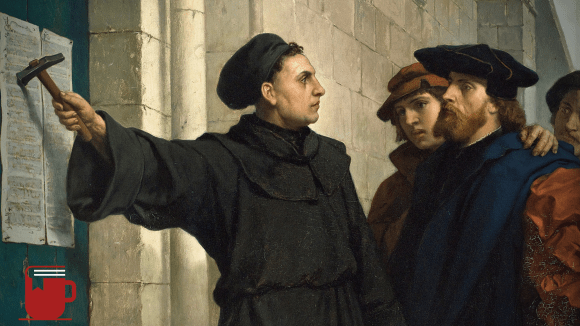
Greetings and salutations readers! This week, I thought we’d pick back up with our 5 Solas posts so as to keep us on track to finish before the anniversary of the start of the Protestant Reformation on October 31st. As I mentioned in my post a couple of weeks ago, this particular post should have gone up later that week. But, as I also mentioned in last month’s book review post, my wife and I have been house hunting and the past few weeks have been a little crazy. I even mentioned to a young lady in my church that I feel as though my brain power has been a bit off over the summer. Quite honestly, I think I may have just hit seminary too hard this spring, especially with Greek.
For the moment, however, I seem to be a little motivated! I’ve got a nice large cup of coffee next to me, a loyal dog at my feet, and (for some odd reason) I also have Tears for Fears playing in the background. So, pull up a chair and let’s look at the next Sola of the Reformation – Sola Fide or Faith Alone.
Sola Fide
I spent a portion of the initial post discussing a brief history of the Protestant Reformation, so I won’t repeat that here. Instead, what I will briefly attempt to do here is to give a little more context regarding the argument between Protestants and, particularly, our Roman Catholic friends.
Let me first begin by defining the term. Sola Fide as I have mentioned above, is the Latin form of the phrase: By Faith Alone. As we continue throughout this post, we will see the varied nuances of what this truly means.
With that said, before we go any further, allow me to note something very important, especially for those who are new to this debate as it is important to defining the language. Regardless of where you might fall on this debate, we are all using the same langauge but we do have very different definitions. I will speak from the Protestant perspective as that is where my experience lies as well as my understanding of this debate has been mostly confined. I do have a great appreciation for Rome and much that the RCC has given us (particularly in the areas of monasticism and even the mystics, but that’s another post for another time).
So, speaking from the perspective of a Protestant, allow me to say this to my Protestant readers: if you were to ask your local parish priest or even RCC friend if they believe that we are saved by Grace through Faith they would answer the exact same way that your local Baptist preacher would – Yes! Aboslutely! The difference, though, in how we define this term comes down to an understanding of justification – How is a person justified (made righteous) before a holy and righteous God?
And here is where our definition begins to get a little more convoluted, but it is here that we must have our understanding of what Faith Alone truly means. In the Protestant understanding, a person is completely justified before God by faith in Jesus Christ. This means that there is literally nothing that a person can do to justify themselves before God. Our justification is laid solely at the feet of Jesus and his atoning work on the cross and his resurrection from the dead. On the flip side of this, our Roman friends understand that a person is not only justified by faith but also by works.
So, while yes, we are saved by faith alone through God’s grace alone, justification is the issue here. Are we justified simply by faith or do works also come into play? To answer this question, we need to turn to Scripture to help us understand how God himself has defined how we are justified.
Scriptural Support
In the ingural post on the 5 Solas, we established the doctrine (or teaching) of Sola Scriptura. As we mentioned in that post, this is an area where Protestants disagree with our Roman friends (allow me to refer you back to that post to see exactly how we disagree). However, at the same time, we would also both point to the same texts of Scripture to give evidence for our understanding of Sola Fide (as well as Sola Gratia, which we will discuss in the next post in this series). Allow me to give you a few of them briefly. Also, for the sake of helping us make the argument for Sola Fide from the Protestant position, I’ll quote these verses from the Douay-Rheims Bible, which is an English translation of the Latin Vulgate originally translated in the late 4th century by St. Jerome and used as the primary tranlsation in the Roman Church from that period until the mid 20th-Century after Vatican II (and in some cases is even still used).
Ephesians 2:8-9 – This first text is probably a gimme for many Protestants, but it is vital to this debate. Under the inpiriation of the Holy Spirit, Paul writes here: “For by grace you are saved through faith, and that not of yourselves, for it is the gift of God; Not of works, that no man may glory.”
Briefly, let’s break this down… For by grace (read Sola Gratia) you have been saved through faith (Sola Fide), and that not of yourselves, for it is the gift of God; not of works... Let’s stop here for a moment. What Paul is saying here, and what we can understand is that, we are saved by God’s grace, through Faith. Not only are we saved through Faith… but this faith isn’t even something that we come up with on our own. Rather, as Paul notes, it is a gift of God. So, not only do we not justify ourselves, we are incapable of even having faith without God graciously giving us the faith to believe in Christ in the first place! And why? Paul tells us in verse 9 – that no man may glory. Meaning, that our faith in Christ is by the grace of God and not of anything that we have merited of our own accord, lest we are able to boast that we have done something to earn God’s favor. This passage alone closes the book on the argument for some, but let’s consider another for the sake of being thorough.
Romans 1:16-17/4:13-5:2 – Okay, I’m cheating here and quoting two passages from the letter of Paul to the Romans (with a reference to Habakkuk 2:4). Yes, I know that I’m referencing Paul again, but the entire letter to the Romans more than most others, lays out the entire New Testament arugment of how God has worked out our salvation through 1. Jesus.
First, let’s consider the passage from chapter 1 that was vital in Martin Luther’s own conversion (and which led to his eventual break with the RCC and the Reformation itself). Again, this is the Douay-Rheims translation: For I am not ashamed of the gospel. For it is the power of God unto salvation to every one that believeth, to the Jew first, and to the Greek. For the justice of God is revealed therein, from faith unto faith, as it is written: The just man liveth by faith.
Quickly, here, just walk through this verse – the Gospel (the good news of the death and resurrection of Jesus) is the power of God for salvation to everyone who believes in Jesus. In the Gospel, the “justice” or righteousness of God is revealed “from faith for faith” or beginning and ending in faith. As it is written in Habakkuk 2:4 – the just man (the righteous) shall live by faith. “Shall live” meaning “shall have salvation” by Faith alone… that is a gift of God grace alone… unless we have reason to boast about ourselves.
Second, I am only going to quote Romans 5:1-2 for the sake of space, but read all of this text starting in chapter 4:13. Again, it’s important to note that this is the English from the Latin Vulgate – Being justified therefore by faith, let us have peace with God, through our Lord Jesus Christ: By whom also we have access through faith into this grace, wherein we stand, and glory in the hope of the glory of the sons of God.
And here is where we now get back to our differences in definitions. Paul, under the inspiration of the Holy Spirit (see 2 Timothy 3:16 & 2 Peter 1:21 for further clarity on what I mean by this), tells us that we are justified (read “made right”) by faith. It is this faith that is only a gift by God’s grace, but we are justified and we have salvation. We are justified before God because of faith in Jesus and only by faith in Jesus “that no man may glory” as Ephesians 2:9 tells us… that none of us can boast that we have done anything to obtain the grace of God.
Here’s the crux of the issue and then I’ll move on to one more passage for the sake of the debate – If we are able to merit any kind of favor before God by our works and by our own deeds and good works and good actions, then it robs the sufficiency of the work of Jesus on the cross and it robs the glory of the Resurrection from Jesus.
But, before I close out this post, let’s look at one more passage. This is the main passage that our Roman friends turn to to make the arugment of Faith plus Works. There may be others, so if you know of them, please educate me!
James 2:14-26 – Certain folks, by considering this passage along with the few that we’ve already looked at could state: “Doesn’t this mean that Scripture is contradicting itself?” Honeslty, that’s a valid question – but here’s my answer: No. Emphatically, no.
Before we go any further, here’s the passage from Douay-Rheims: What shall it profit, my brethren, if a man say he hath faith, but hath not works? Shall faith be able to save him? And if a brother or sister be naked, and want daily food: And one of you say to them: Go in peace, be ye warmed and filled; yet give them not those things that are necessary for the body, what shall it profit? So faith also, if it have not works, is dead in itself. But some man will say: Thou hast faith, and I have works: shew me thy faith without works; and I will shew thee, by works, my faith. Thou believest that there is one God. Thou dost well: the devils also believe and tremble. But wilt thou know, O vain man, that faith without works is dead? Was not Abraham our father justified by works, offering up Isaac his son upon the altar? Seest thou, that faith did co-operate with his works; and by works faith was made perfect? And the scripture was fulfilled, saying: Abraham believed God, and it was reputed to him to justice, and he was called the friend of God. Do you see that by works a man is justified; and not by faith only? And in like manner also Rahab the harlot, was not she justified by works, receiving the messengers, and sending them out another way? For even as the body without the spirit is dead; so also faith without works is dead.
Uh oh… Now Protestants have to answer the questions brought up in this passage. Honestly, one of the true stories of history is that Luther hated the book of James. He couldn’t stand it! And this passage here seems to completely trip up our argument, doesn’t it? Let’s look at it though in light of what is being said as well as allowing Scripture to interpret itself.
First, we need to move forward with understanding that our God is not the author of confusion (see 1 Corinthians 14:33) – if the Bible were to cause confusion because it contradicts itself, then God is the author of confusion and therefore a liar and we all have no hope and above all peoples of the earth are to be pitied because we put our hope and faith in a liar. So… understanding that God is not the author of confusion, how does this passage from James work in light of Sola Fide? A simple sentence will suffice and then we can discuss back and forth with one another: James notes that “faith without works is dead” – this is because if you say you have faith and do not live your faith, there is no outward proof of your faith.
But, the right question to ask here is: proof for whom? Not God, because we have been saved by his grace through the faith he has given us so that we in no way can boast that we have merited his favor. Remember, since we have been justified by faith, we have peace with God through the Lord Jesus (Romans 5:1).
So, what’s James’ point here? The point is that without an outward working of your faith, without living out your faith, you might as well be screaming into the wind. It’s no good. There’s no proof of your faith. Quite frankly, his point is “how can you claim Christ if you are unwilling to live out that love towards others?” You can say you believe in Jesus until you’re blue in the face, but if your faith doesn’t prove itself by works then do you even really believe? This is why James walks through the examples of Abraham and Rahab throughout the rest of this text.” In these examples, their faith was proved by their works and then their faith was “counted as righteousness.”
Let me make one final comment on this and then I’ll finish up this post and. I want to hear from you all:
These are hard mysteries that God has revealed to us. In our fallen nature, I think we have made many things bigger issues than we probably should and that is why there is such division among the community of believers around the globe. That being said, however, I do think we have to end this Sola, as well as the next one, with this question: is the work of Jesus on the cross and his resurrection from the grave sufficient for our justification before God or not? If it is, then we are left with no other option but to say that our justification is nothing less than by God’s grace alone through the faith that He and He alone has given us to believe.
There’s a lot more that could be said on this topic. Indeed there have been books and articles written completely on this Sola. But, I want to hear from you. Protestant, Roman, Orthodox, share your thoughts and resources… with love and grace. What more can be said? Where have I erred? Let’s discuss!

 The SouthTown Pastor
Praise God! I found a post that uphold the Five Solas!
LikeLike